Redesigned a wholesale product page from shop-floor research
AJIO Business is where shop owners across India buy stock in bulk. Apparel, footwear and sarees, all sold by the pack. I redesigned the product page so a shop owner can see what is inside a pack before they buy it, and try a new brand without committing to a full order.
- What it is
- The page where a shop owner decides what stock to buy
- What I owned
- Interaction design and content design on that page
- Who it was for
- Retailers buying in bulk, not people shopping for themselves
- What changed
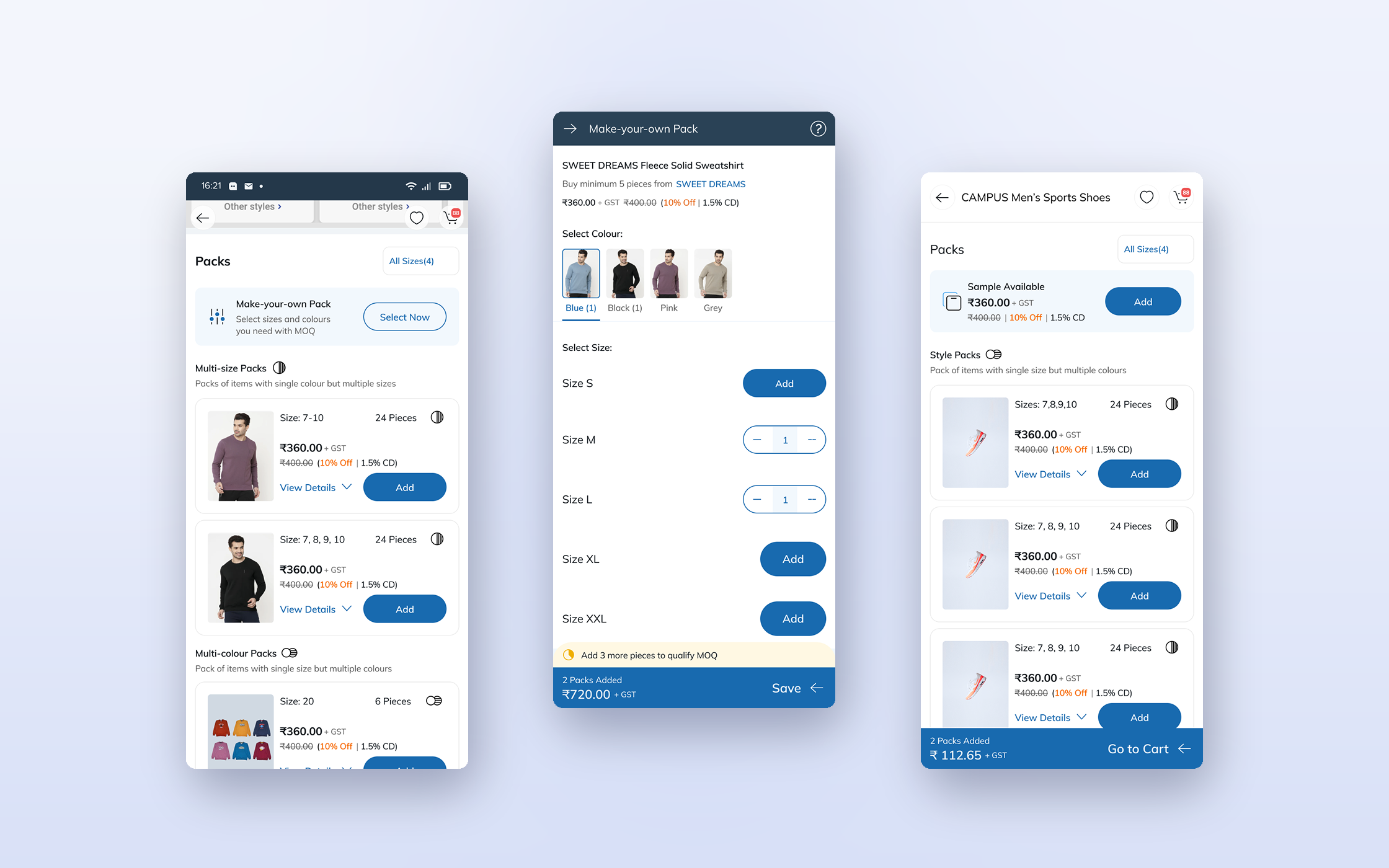
- Packs you can read without having to open one
- Problem
- Stock is sold in packs, and the old page kept packs shut. Retailers could not tell what was inside one until it arrived. They could not change a pack to fit their area, and they could not try a new brand without ordering its full minimum. So many of them bought offline instead.
- My move
- I sat with retailers in three cities, then rebuilt the product page. Packs named and explained on the card itself, a way to build your own against the brand's minimum and sampling for a first order from a brand you do not know yet. I wrote the words as well as designing the screens.
- Outcome
- Shipped on a platform serving 8.8 lakh monthly active merchants. In usability testing, merchants read and compared pack contents from the collapsed cards without opening a single one.
- Learning
- Agree the pack names with retailers before locking the components. We designed the UI first, then spent the rest of the project explaining names the retailers never chose.
Every retailer wanted the same thing: to know exactly what they're getting before the money leaves.
What three cities of interviews boiled down to
One page decides whether the stock gets bought
Everything upstream leads to the product page. It's where a shop owner looks at one product and decides if it will sell in their shop.
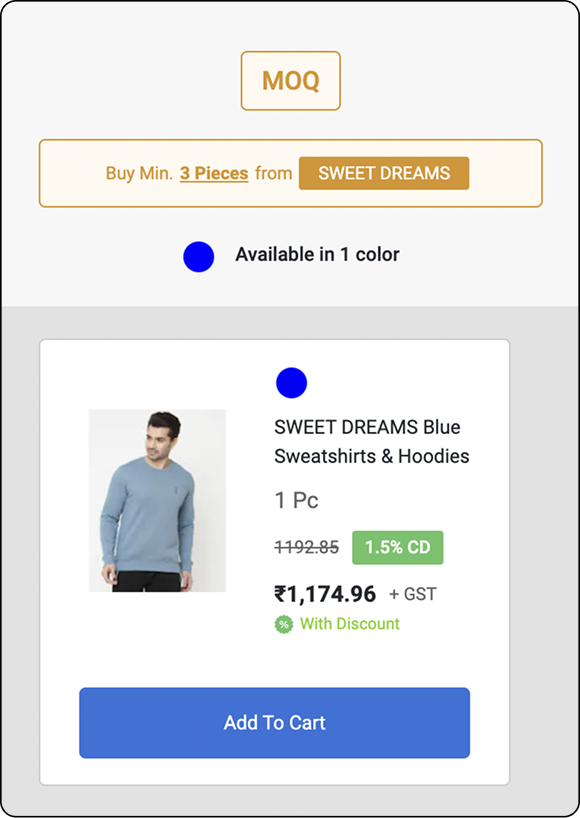
AJIO Business is a wholesale app. Shop owners across India stock their shelves with apparel, footwear and sarees ordered in bulk. Stock comes in packs, a fixed bundle of sizes and colours, and every brand sets a minimum order quantity (the MOQ) below which it won't sell.
On the surface it looks like Amazon or Flipkart. The motive couldn't be more different: nobody here is shopping for themselves. Every order is inventory, and every tap is a margin calculation. Design instincts imported from consumer e-commerce break quietly on this page.
I worked on the product detail page, the screen where a retailer weighs one product and decides. I was the product designer alongside UX Research, and I owned the content design too: what every new feature was called, and how it explained itself at the point of decision.
- “Will this sell?”
- “Do sizes fit my region?”
- “Can I trust this brand?”
- “Can I test before buying?”
Three ways the old page lost the sale
You could not see inside a pack, change one to fit your shop, or try a new brand first. Retailers solved all three by buying offline.
The pack was a mystery box
An “assorted pack” could mean anything: 2 pieces per size, or 4 of one size and none of the rest. You found out after paying. Guess wrong and the leftover sizes sit on the shelf for months.
No way to adjust a pack
Size demand varies by region, but packs came fixed. A retailer who needed more of a fast-selling size had no option on the app, so they went to the local wholesaler who would oblige.
No way to try a brand
Meeting a new brand meant committing to its full minimum order on the first date. There was no small way in, so retailers stayed with the brands they already knew.
What retailers told us in three cities
Footwear, apparel and sarees each define a good pack differently. Every interview ended in the same place. Nobody spends money on a pack they cannot picture.
We sat with retailers in their own shops across three cities, footwear, apparel and sarees, and ran online sessions alongside. The people who run the categories and the regional seller teams gave us the other side of the story.
I walked into those shops ready to fight the term MOQ. Too jargony for a UI, kill it, that was my B2C instinct. Then I heard wholesalers use it in ordinary conversation, shop after shop. It was their word, not ours. It stayed in the interface exactly as they say it, and I stopped trusting my defaults from consumer apps for the rest of the project.
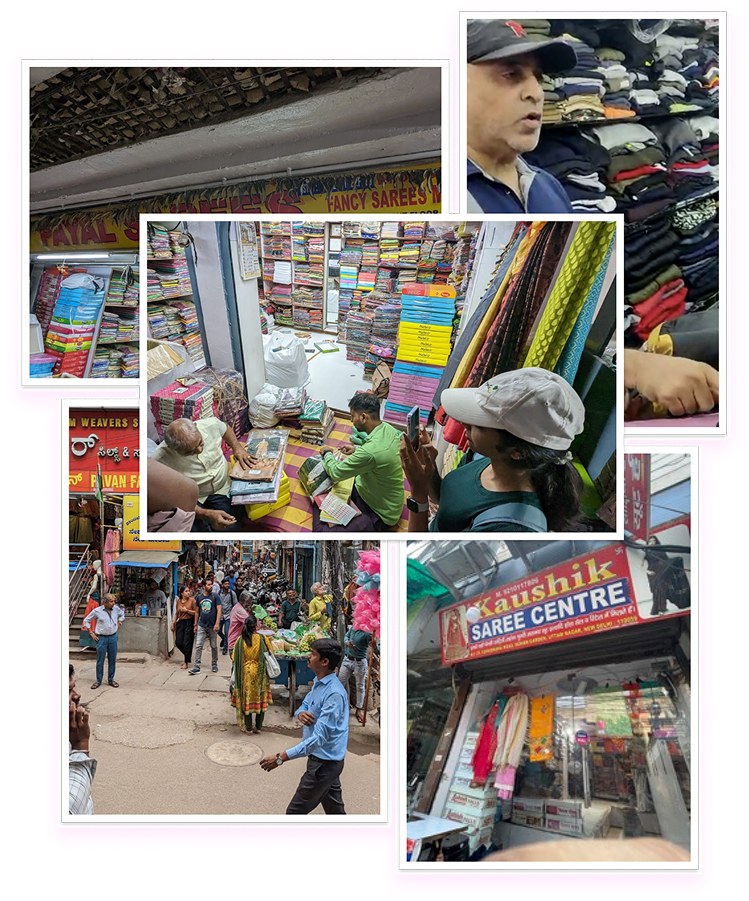
“Smaller sizes sell more: 6, 7, 8, especially 7 and 8. Stock of 9, 10 always stays with me.”
Size demand is regional. A one-size-fits-India pack turns into stock the shop can't move.
“I don't want to re-buy a full pack when some 8s and 9s are left. I wait for it to sell out first.”
With no way to top up just the sizes that sold, retailers waited or bought offline. The app never even saw that demand.
“Offer samples or small-quantity packs to try and buy, especially for new brands and high price points.”
A first order from an unknown brand is real money at risk. Every category asked for a smaller way to start.
Five calls that rebuilt the page
Every change removes one reason a retailer gave us for buying offline instead.
123- 1Pack types, named and explained where the decision happens.
- 2Make-your-own Pack: pick sizes and colours, minimums tracked live.
- 3e-Sample: order below the minimum to test a new brand first.
Collapsed pack cards, expandable on demand
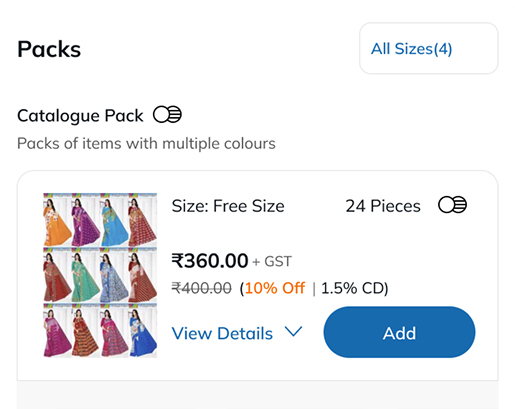
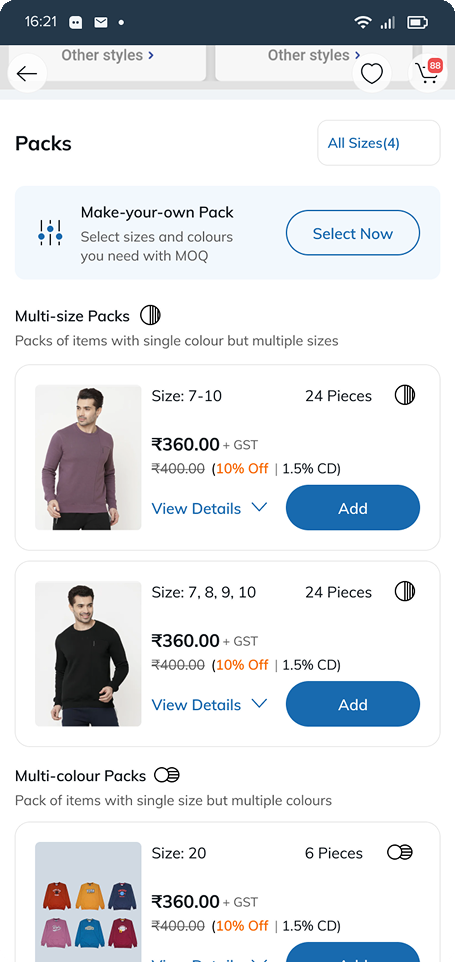
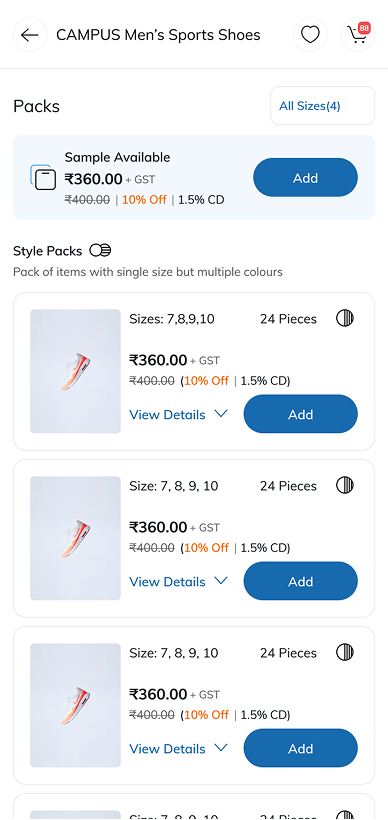
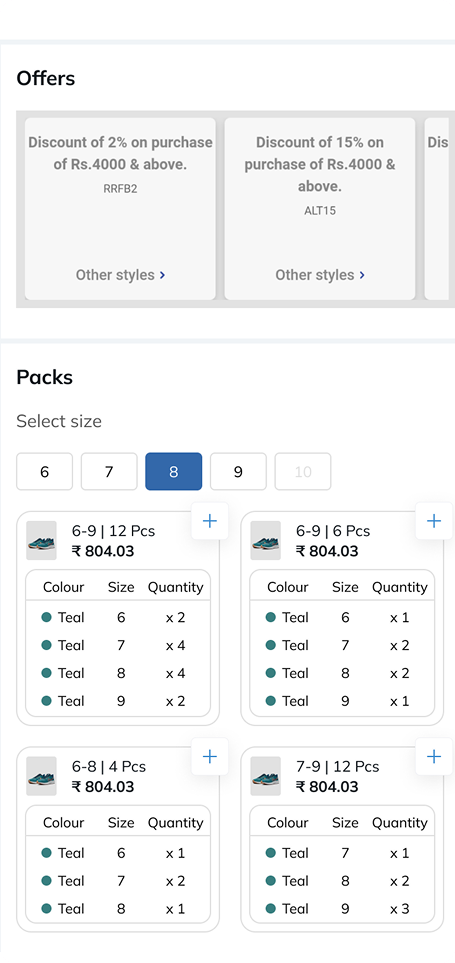
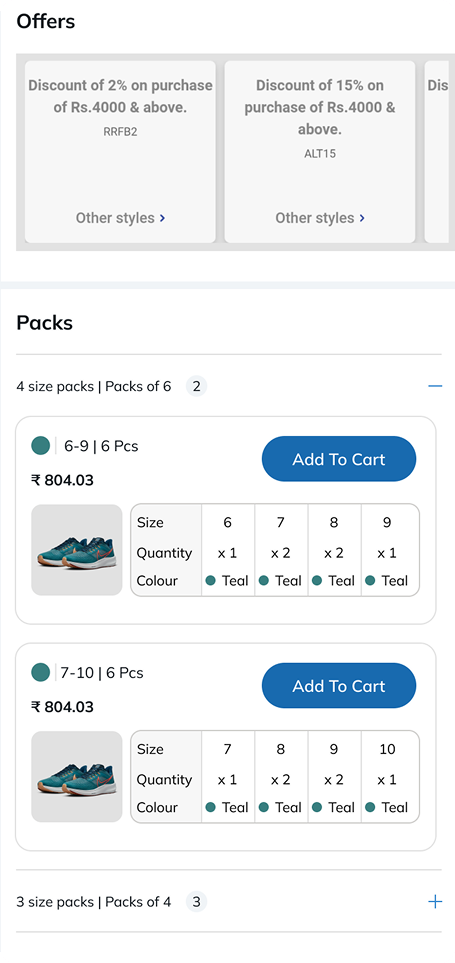
A retailer does two jobs on this screen: scan every pack to shortlist, then study one closely before paying. Collapsed, a card shows just enough to compare on: pack type, sizes, piece count, price. Expanded, it shows exactly which pieces you get, size by size.
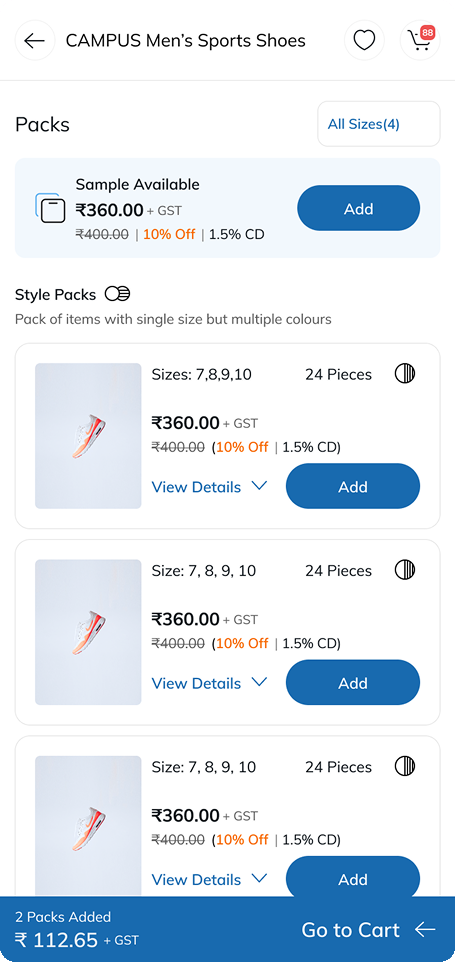
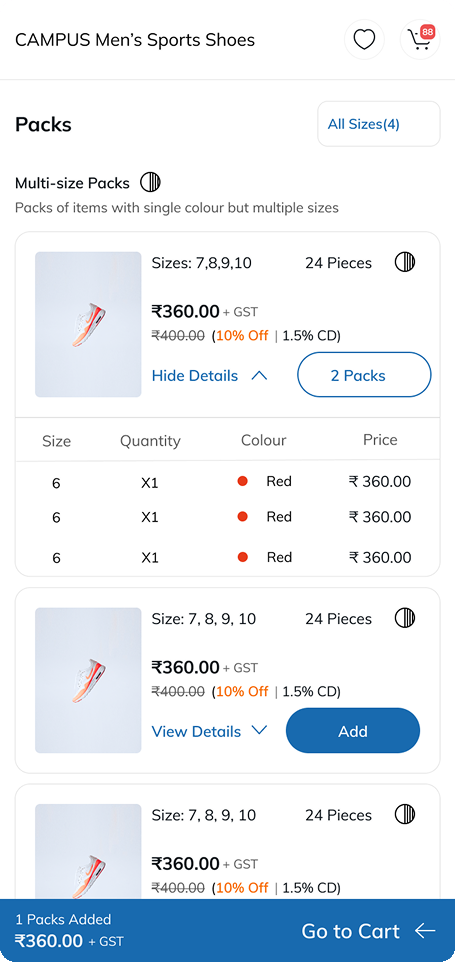
A pack-type taxonomy, named and explained on the card
Half this work was naming. We defined six pack types, each with a name, an icon and a one-line explanation that lives on the card itself, where the money decision happens. A retailer should never have to learn our vocabulary to buy stock.
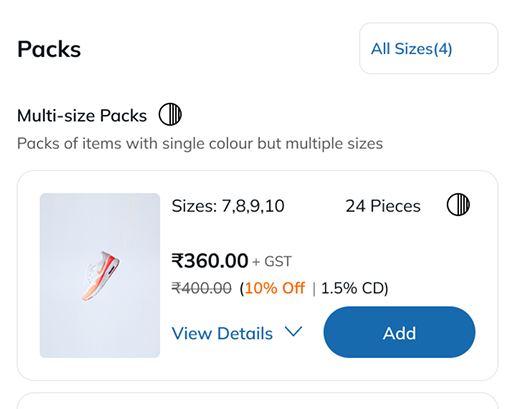
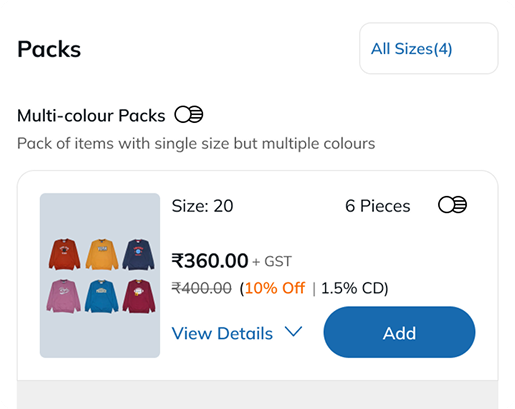
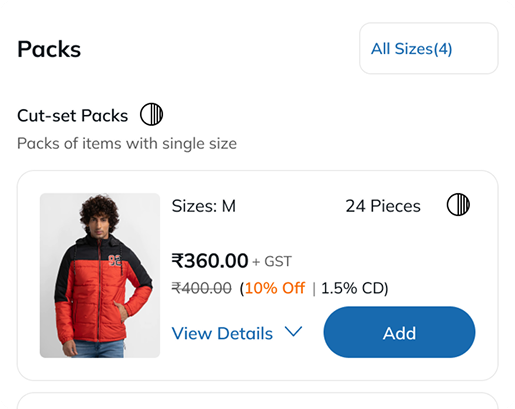
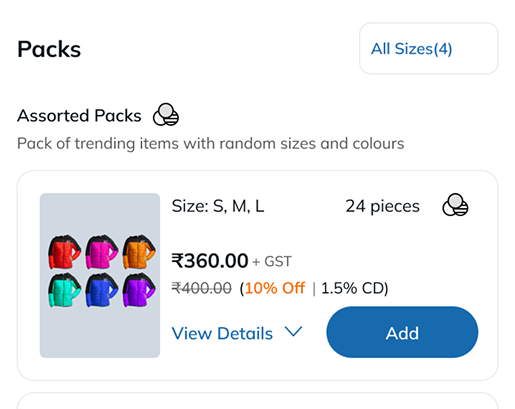
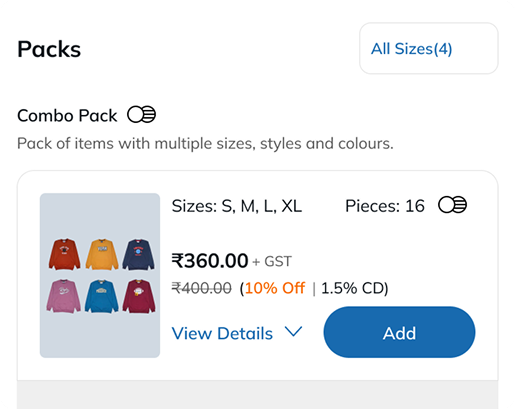
Make your own pack when the catalogue falls short
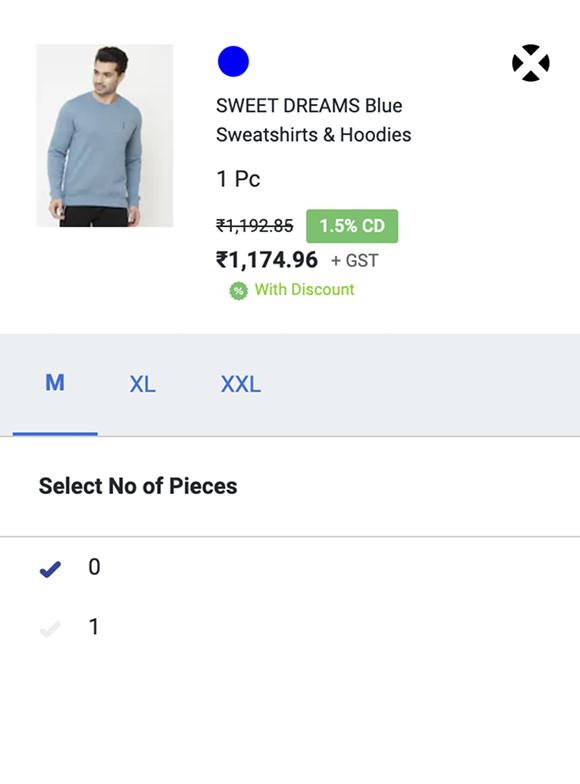
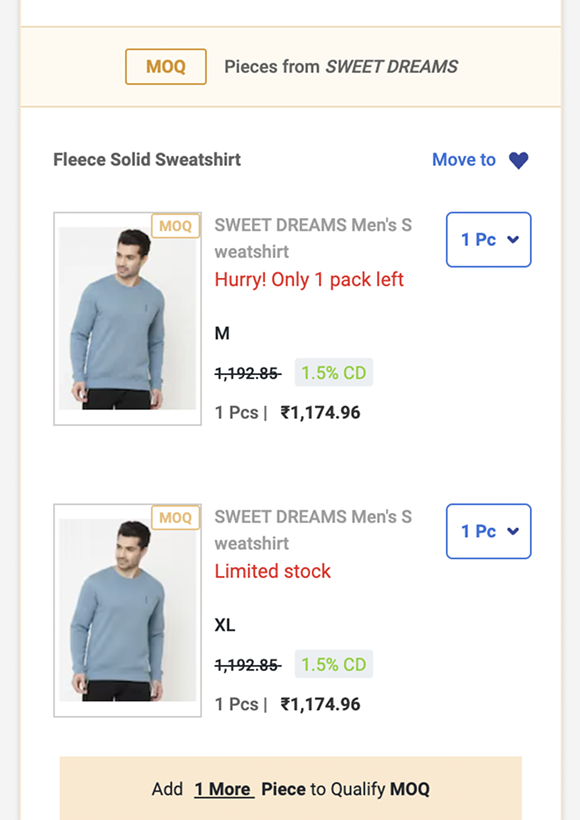
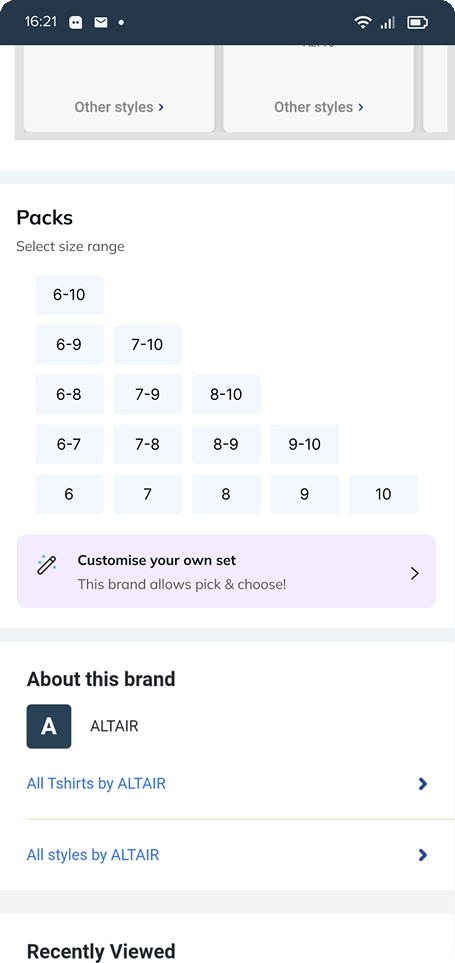
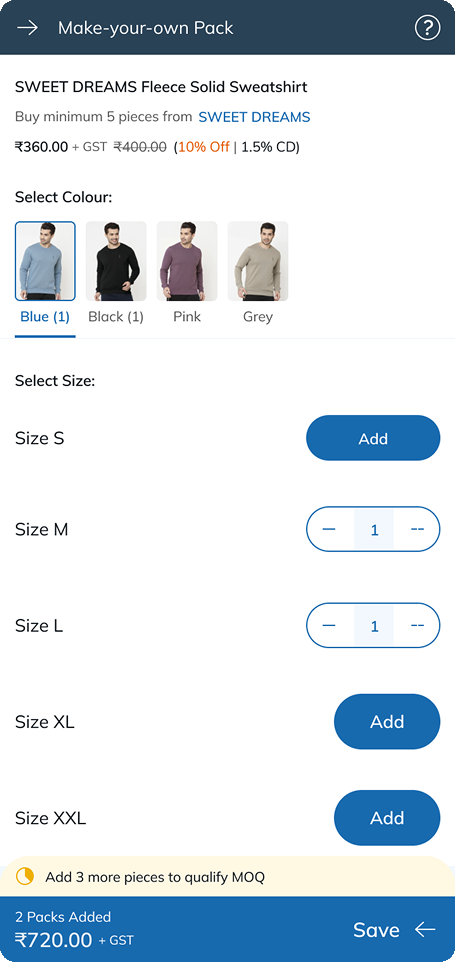
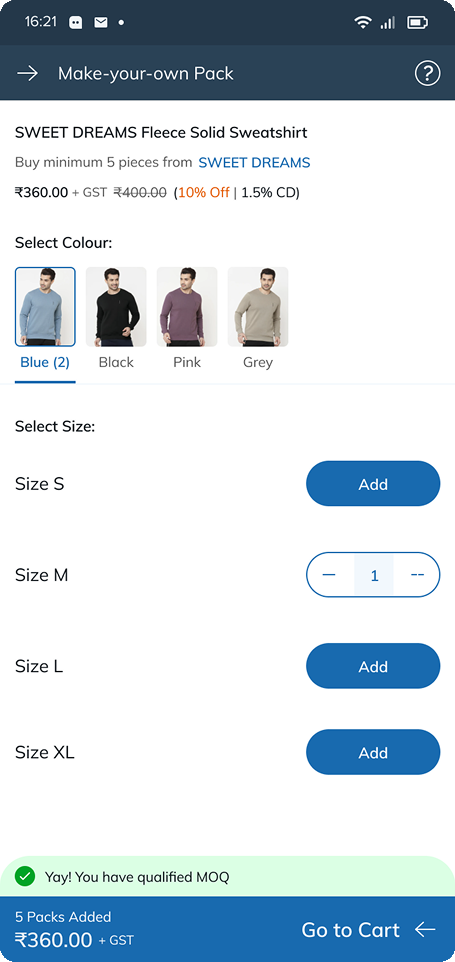
When no pack matched their shop, retailers used to have one option: leave. Make-your-own Pack lets them build one piece by piece, colours and sizes, with the brand's minimum counting up live as they add. You qualify before you reach the cart.
It has two front doors. A banner on the product page for the retailer who discovers it while browsing, and an entry inside size selection for the one who walked in knowing exactly what their shelf needs.
e-Sampling for the first buy from an unknown brand
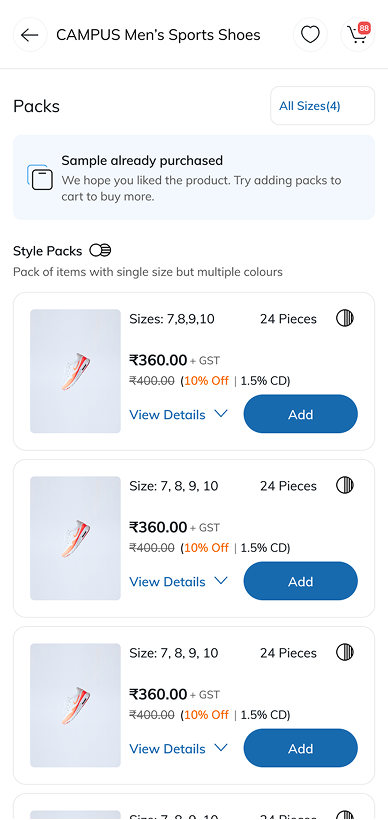
The hardest moment is buying from a brand you have never stocked before. Research said it in every city: let me try first. e-Sampling lets a retailer order below the minimum, put the product in their shop and then commit to a full pack.
What we scrapped, and what had to wait
A compact pack card worked beautifully for shoes and fell apart for sarees, so it went. Filtering by pack type on the listing page needed pack data tagged upstream by another team, so we designed the page ready for it and let the filter wait on their timeline.
Shipped to 8.8 lakh merchants
In usability testing on the new page, merchants read and compared what's inside a pack from the collapsed cards alone, without expanding one. Both jobs the card had to do, scanning and studying, held up.
The big numbers belong to the whole platform. Feature-level adoption was never tracked separately, so I won't pretend to own them. What I do own: every feature above answers a hesitation retailers described to our faces.
What I'd do differently
Agree the pack language with retailers before locking the components. We spent the project explaining names the data model chose.
The pack names came from our catalogue structure, not from retailers, and the UI spent the rest of the project compensating: icons, labels and inline copy, all load-bearing. Necessary work, but it was carrying weight that shared language would have carried for free. With the runway again, I'd run a card sort on pack terminology before drawing a single wireframe.
The irony isn't lost on me. The field visits taught me to keep the retailer's own word for the minimum order, and we still shipped six pack names retailers never chose.
- Cut-set · one size, for restocking
- Multi-size · one colour, a run of sizes
- Multi-colour · one size
- Catalogue · free size
- Combo · chosen mix
- Assorted · trending mix